Documents You Need for International Courier Shipping from India: Complete 2026 Guide
Sending a parcel from India to another country may seem simple, but international shipments require the right documentation. Whether you are sending personal belongings, business products, educational documents, gifts, samples, or important paperwork, proper documentation helps customs authorities understand what is being shipped, who is sending it, who will receive it, and what the shipment is worth.
Missing or incorrect documents can result in customs delays, additional charges, shipment returns, or clearance problems. The exact requirements also depend on the destination country, type of shipment, value of goods, and whether the shipment is personal or commercial.
For exports of goods from India, DGFT’s Foreign Trade Policy lists the Airway Bill/Bill of Lading or equivalent transport document, Commercial Invoice cum Packing List, and Shipping Bill/Bill of Export/Postal Bill of Export among the mandatory export documents.
This guide explains the most common documents required for international courier shipping from India, when each document is needed, and how to prepare your shipment correctly.
Why Are Documents Important for International Courier Shipping?
International parcels cross borders and therefore need to comply with customs and trade regulations in both the origin and destination countries.
Documentation helps customs authorities verify:
- Sender information
- Recipient information
- Contents of the shipment
- Quantity of items
- Declared value
- Country of origin
- Purpose of shipment
- Applicable customs requirements
Indian courier export regulations also require export packages to carry a declaration from the sender or consignor regarding the contents of each package and its total value.
In simple terms, the parcel tells customs what you are sending, while the documents explain the shipment in detail.
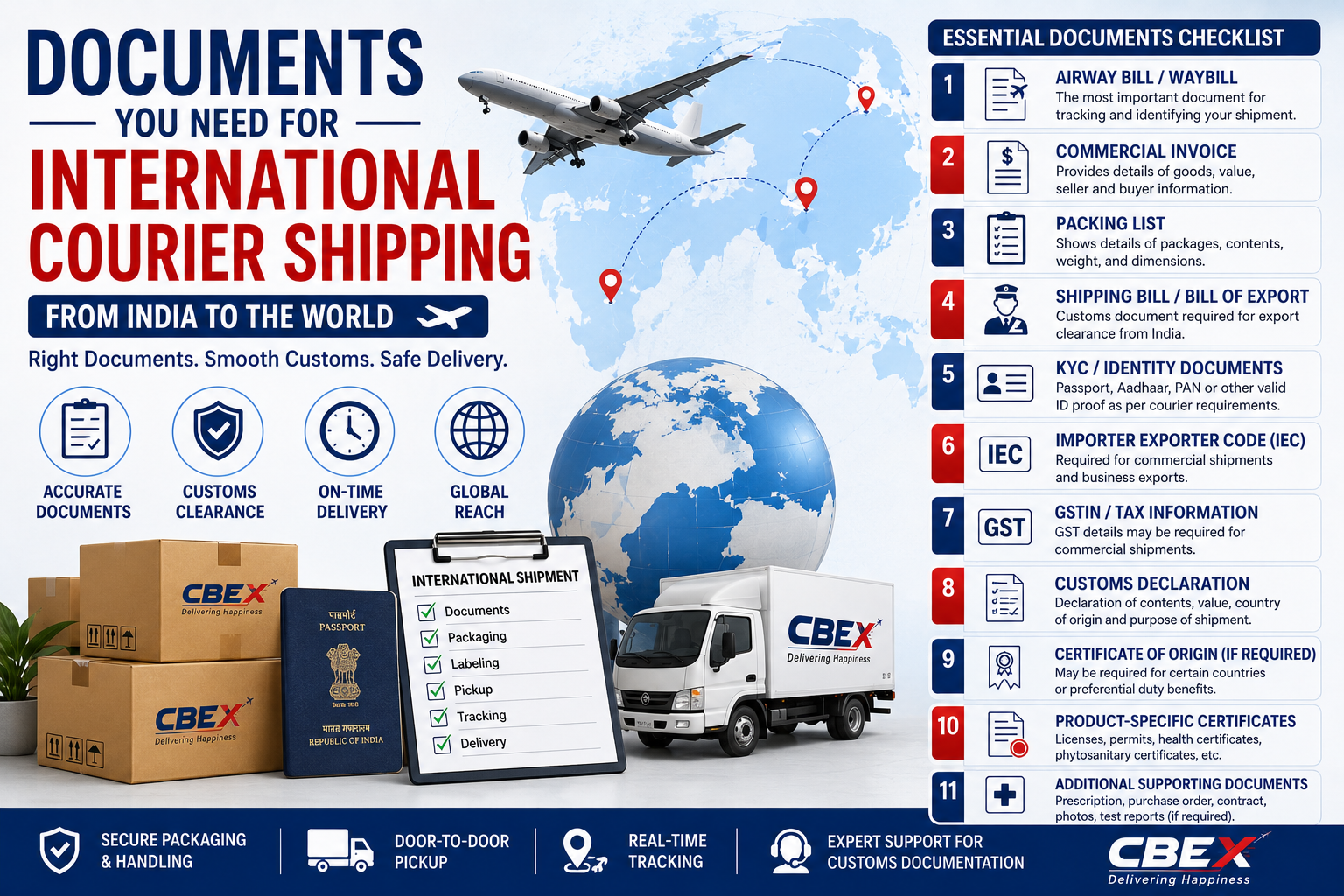
1. Airway Bill or Courier Waybill
The Airway Bill (AWB) is one of the most important documents in international courier shipping.
It acts as the shipment’s transportation document and contains information such as:
- Sender’s name and address
- Recipient’s name and address
- Destination country
- Shipment details
- Package information
- Tracking number
- Courier information
The AWB number is particularly important because it allows you to track your shipment during transit.
For courier shipments, your courier provider generally creates the airway bill after collecting the required shipment information.
Why Is the AWB Important?
It helps identify and track the parcel throughout its journey, from pickup and origin processing to international transportation, customs clearance, and final delivery.
2. Commercial Invoice
A Commercial Invoice is one of the most important documents when shipping goods internationally, particularly for commercial shipments.
It provides customs authorities with information about the transaction and the goods being shipped.
A commercial invoice commonly includes:
- Exporter’s name and address
- Importer’s name and address
- Invoice number
- Invoice date
- Description of goods
- Quantity
- Unit price
- Total value
- Currency
- Country of origin
- Terms of sale, where applicable
- Shipment information
A clear description is important.
Instead of writing:
“Items – 5 kg”
provide a more useful description such as:
“Cotton men’s shirts – 10 pieces”
or
“Plastic machine components – 20 pieces”
The exact information required can vary according to the shipment and destination.
3. Packing List
A Packing List provides detailed information about how the shipment has been packed.
It may include:
- Number of packages
- Description of contents
- Quantity
- Gross weight
- Net weight
- Package dimensions
- Package numbers
- Shipping marks
For larger or commercial shipments, the packing list helps customs officials and logistics teams verify the physical shipment against the documentation.
DGFT’s Foreign Trade Policy identifies the commercial invoice cum packing list among the mandatory documents for export of goods from India.
4. Shipping Bill or Bill of Export
For exports from India, the Shipping Bill, Bill of Export, or applicable Postal Bill of Export is an important customs document.
For courier exports, customs processing is handled through the courier framework and electronic systems. CBIC’s courier regulations include specific procedures and forms for export clearance, including Courier Shipping Bills.
The exact document and filing process depend on the nature of the shipment and the applicable export procedure.
A professional courier provider can help determine which customs documentation is required for your shipment.
5. KYC and Identity Documents
Courier companies may require Know Your Customer (KYC) documents to verify the identity and address of the sender.
Depending on the shipment and courier provider, individuals may be asked for documents such as:
- Passport
- Aadhaar
- PAN
- Driving licence
- Other accepted government-issued identification
- Address proof
The exact KYC requirements can vary by courier company and shipment type.
Why Is KYC Required?
KYC helps establish who is sending the shipment and supports compliance with customs and courier regulations.
Always provide documents that are valid, clear, and match the information provided during booking.
6. Importer Exporter Code (IEC)
An Importer Exporter Code (IEC) is especially important for businesses involved in international trade.
DGFT states that IEC is mandatory for import/export from or to India, subject to applicable provisions and exceptions.
Businesses may need to provide their IEC information when exporting commercial goods.
The IEC is used as an important identification reference in India’s export-import system.
Who Usually Needs an IEC?
It is particularly relevant to:
- Exporters
- Manufacturers
- Online sellers
- E-commerce businesses
- Trading companies
- Commercial suppliers
However, the requirement can depend on the nature of the transaction and applicable exemptions. For a specific shipment, confirm the requirement with your courier or customs professional.
7. GSTIN and GST-Related Information
Businesses registered under GST may need to provide their GSTIN and relevant tax information for applicable export transactions.
CBIC’s courier export documentation includes fields for GSTIN and related invoice information in applicable courier shipping documentation.
The requirement depends on the nature of the exporter and transaction.
If you’re shipping commercial goods, keep your GST and invoice information accurate and consistent across your documents.
8. Customs Declaration
A customs declaration provides information about what is being shipped and its value.
For courier exports, the sender must accurately declare the contents and value of the package. CBIC’s courier regulations specifically provide for a sender/consignor declaration of the contents and total value of packages.
A customs declaration may include:
- Description of goods
- Quantity
- Value
- Currency
- Country of origin
- Purpose of shipment
Never Underdeclare the Value
Some people assume that declaring a lower value will reduce customs charges. This can create problems.
Incorrect valuation can result in:
- Customs queries
- Delays
- Reassessment
- Additional charges
- Shipment complications
Always provide truthful and accurate information.
9. Purchase Order or Sales Documents for Commercial Shipments
Businesses may need additional commercial documentation depending on the transaction.
Examples include:
- Purchase order
- Sales order
- Proforma invoice
- Commercial contract
- Payment documentation
- Product catalogue or specification
Not every shipment requires all of these documents. However, they can be useful when customs authorities or logistics providers need additional information about the transaction.
10. Certificate of Origin
A Certificate of Origin (COO) identifies the country in which goods originate.
It may be required or useful depending on:
- Product type
- Destination country
- Trade agreement
- Import requirements
- Customs treatment
For certain shipments, a Certificate of Origin may help establish eligibility for preferential treatment where applicable.
DGFT provides an electronic platform for certificates of origin, including preferential and non-preferential certificates.
Your courier or export advisor can confirm whether one is needed for your specific shipment.
11. Product-Specific Licences and Certificates
Certain products require additional documentation because they are regulated.
Examples can include:
- Food products
- Pharmaceuticals
- Medical devices
- Cosmetics
- Chemicals
- Agricultural products
- Plant materials
- Animal products
- Electronics
- Controlled or restricted goods
Depending on the product, authorities may require certificates, licences, permits, test reports, or other supporting documents.
Before shipping a regulated product, check both India’s export requirements and the destination country’s import rules.
12. Prescription or Supporting Documents for Medicines
Medicines require special attention.
A shipment containing medicines may require:
- Prescription
- Doctor’s letter
- Medicine details
- Quantity information
- Supporting import documentation
Whether a medicine can be shipped depends on the destination country’s laws and the specific product.
Never assume that a medicine permitted in India is automatically permitted in another country.
Always verify the destination country’s rules before booking the shipment.
13. Food and Agricultural Product Documents
Food, seeds, plants, spices, animal products, and agricultural goods can be subject to strict import controls.
Depending on the destination and product, additional documents may include:
- Health certificate
- Phytosanitary certificate
- Food-related certificates
- Product ingredient information
- Import permit
- Sanitary documentation
These requirements vary significantly between countries.
If you’re planning to send food or agricultural products internationally, check the destination country’s regulations before packing the shipment.
14. E-Commerce Export Documents
Online sellers increasingly ship products internationally through e-commerce platforms and courier companies.
An e-commerce export shipment may require information such as:
- Seller/exporter details
- Product description
- Product quantity
- Selling price
- Buyer details
- Order number
- Transaction information
- Invoice
- Customs declaration
CBIC has introduced electronic systems and procedures for courier exports, including e-commerce-related processing.
This makes accurate digital documentation increasingly important for online businesses.
Personal Shipments vs Commercial Shipments
One of the most important things to understand is that not every international parcel requires the same documents.
Personal Shipments
Examples include:
- Clothes
- Books
- Gifts
- Personal belongings
- Documents
You may typically need:
- KYC/identity information
- Airway bill
- Shipment declaration
- Contents and value details
- Additional documents depending on the item
Commercial Shipments
Businesses may additionally need:
- Commercial invoice
- Packing list
- IEC
- GST-related details, where applicable
- Shipping/customs documentation
- Product-specific certificates
- Other export documents
The requirements depend on the goods and transaction.
How to Prepare Your Documents Before Pickup
Preparing documents before the courier arrives can save time and reduce the chance of delays.
Step 1: Identify the Shipment Type
Decide whether the parcel is:
- Personal
- Gift
- Document
- Commercial
- Sample
- E-commerce shipment
Step 2: Check the Destination Rules
The destination country may have specific restrictions.
Step 3: Prepare the Invoice
For goods, provide a clear and accurate description and value.
Step 4: Prepare KYC
Keep your identity and address documents ready if requested.
Step 5: Check Business Documents
If you’re exporting commercially, confirm your IEC, GST details, and other applicable documents.
Step 6: Verify the Package
Ensure the physical contents match your declaration.
Step 7: Keep Copies
Save digital or physical copies of important documents and your airway bill.
Common Documentation Mistakes to Avoid
Incorrect Product Description
Avoid vague descriptions such as “gift” or “items” when a more specific description is required.
Wrong Value
Declare the genuine value required for the shipment.
Incorrect Recipient Details
Double-check:
- Name
- Address
- Postal code
- Phone number
- Email address
Missing Documents
Check with your courier before pickup to confirm the required documents.
Mismatched Information
The details on your invoice, package, and shipping documents should be consistent.
Ignoring Destination Rules
Indian export clearance is only one part of the process. The destination country’s import rules also matter.
How CBEX Can Help With International Courier Shipping
International shipping becomes easier when you work with a courier provider that understands documentation and customs processes.
CBEX provides international courier solutions for individuals and businesses shipping from India to destinations around the world.
Depending on the shipment, CBEX can assist customers with:
- International parcel shipping
- Document courier
- Door-to-door pickup
- Shipment tracking
- Packaging guidance
- Customs documentation support
- Commercial shipments
- Business logistics
CBEX also provides courier coverage across major Indian locations, including Guntur, Hyderabad West, Hyderabad, Vijayawada, Vizag, Chennai, Mumbai, New Delhi, Bengaluru, Cochin, Ahmedabad, Guwahati, and Chandigarh.
Before sending a shipment, provide accurate details about the contents, destination, weight, value, and purpose, so the appropriate documentation can be identified.
Final International Courier Document Checklist
Before handing over your parcel, check:
- Sender details are correct
- Recipient details are complete
- Airway bill information is accurate
- Contents are described correctly
- Shipment value is declared accurately
- Commercial invoice is ready, if applicable
- Packing list is ready, if applicable
- KYC documents are available
- IEC is available for applicable commercial exports
- GST details are available where applicable
- Product-specific certificates are prepared where required
- Destination-country requirements have been checked
- Copies of important documents are saved
Frequently Asked Questions
What documents are required for international courier shipping from India?
Common documents can include an airway bill, shipment/customs declaration, KYC information, and commercial invoice/packing list for applicable goods. Commercial exports may also require shipping/customs documentation and IEC-related information.
Is a commercial invoice mandatory for every international parcel?
Not necessarily in the same form for every shipment. Requirements depend on whether the shipment contains documents or goods, its purpose, value, and destination. For exports of goods, DGFT lists a commercial invoice cum packing list among the mandatory export documents.
Do I need an IEC to send an international courier?
IEC requirements depend on the nature of the import/export transaction and applicable exemptions. For commercial exports, IEC is generally an important requirement under India’s foreign trade framework.
Can I send personal items internationally?
Yes, subject to the rules of India and the destination country. Personal shipments still need accurate declarations and may require additional documents depending on their contents.
Can I send gifts internationally?
Gifts can be shipped internationally, but they remain subject to customs and destination-country requirements. The contents and value should be declared accurately.
What happens if documents are missing?
The shipment may be delayed while the courier, customs authority, sender, or recipient provides the missing information. In some cases, additional charges or return-to-origin procedures may apply.
Do I need a packing list?
A packing list is particularly useful for goods and commercial shipments. DGFT identifies a commercial invoice cum packing list among the mandatory export documents for goods from India.
Are medicines allowed in international courier?
It depends on the medicine and destination country. Prescription and other supporting documentation may be required, and some medicines may be prohibited or restricted.
Can courier companies help with customs documentation?
Many international courier providers offer guidance on the documents and information needed for customs processing. However, the sender remains responsible for providing accurate information and complying with applicable regulations.
Conclusion
International courier shipping from India is much easier when your documents are prepared correctly. The basic requirements can include an airway bill, accurate shipment declaration, KYC information, commercial invoice, packing list, and customs/export documentation, while commercial or regulated shipments may require additional documents.
The most important rule is simple: describe your shipment accurately, declare its value correctly, provide complete sender and recipient information, and check the requirements of the destination country before shipping.
For businesses, keeping documents such as IEC, GST-related information, invoices, and product-specific certificates ready can make the export process smoother.
For personal shipments, preparing accurate KYC, contents, value, and recipient information can help avoid unnecessary delays.
Regulations and destination-country requirements can change, so always confirm the current requirements with your courier provider and the relevant authorities before dispatch. India’s CBIC currently operates the Express Cargo Clearance System (ECCS) for courier processing at multiple international courier terminals, and its official resources provide current regulations, advisories, and shipment-status tools.
With the right documents and a reliable courier partner such as CBEX, sending parcels and documents from India to international destinations can be a much more straightforward experience.