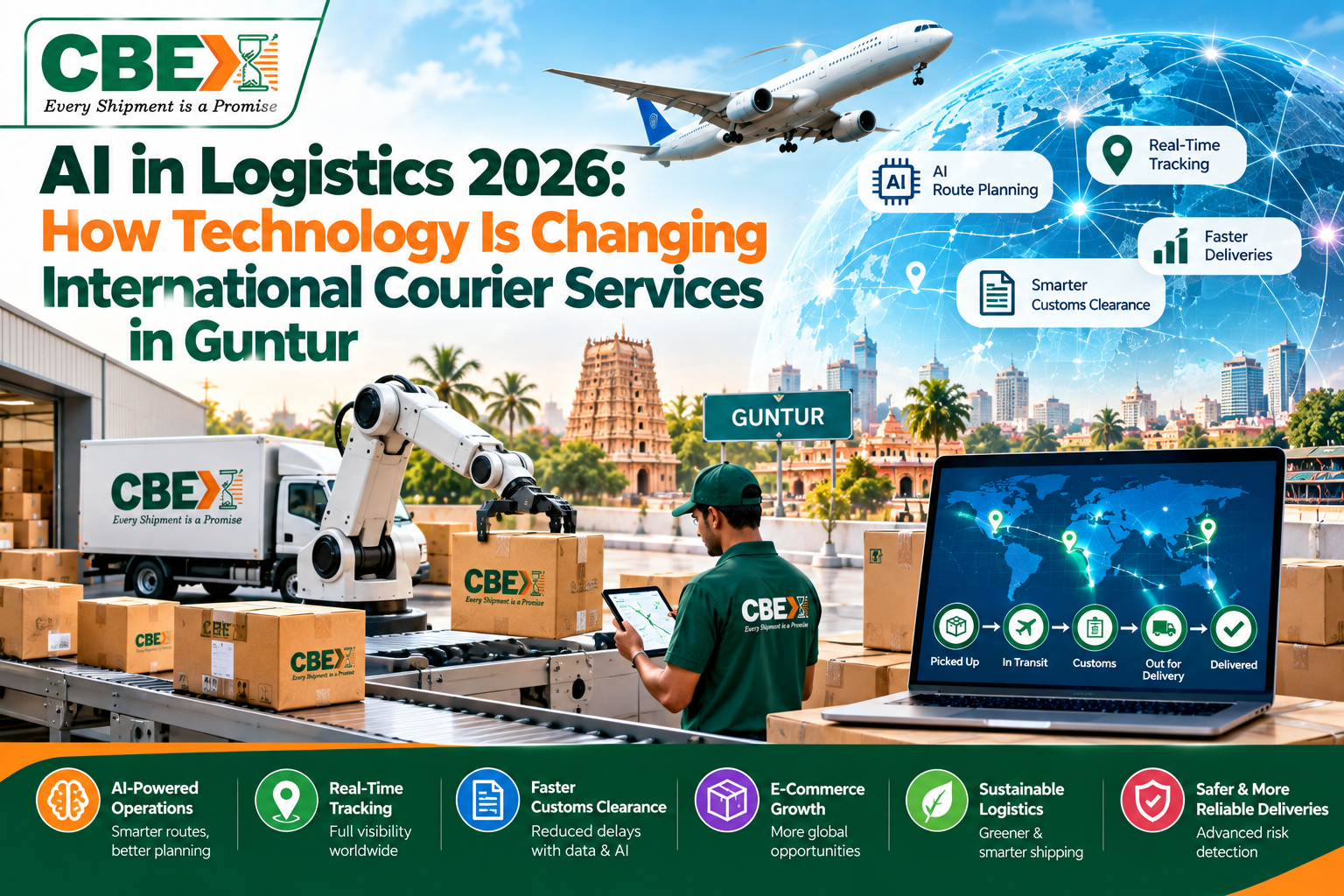
How Technology Is Changing International Courier Services in Guntur
Artificial intelligence is changing the way modern logistics companies plan shipments, manage operations, analyze data, improve tracking, and identify potential disruptions. For customers searching for International Courier Services in Guntur, these developments are becoming increasingly relevant as international shipping becomes more digital, connected, and data-driven.
In September 2026, DHL’s latest Logistics Trend Radar reported that AI is moving beyond simple assistance toward systems capable of supporting planning, decision-making, and execution across supply chains. The report identifies Agentic AI, AI Analytics, robotics, automation, and sustainability among the technologies and trends shaping logistics.
At the same time, India is testing AI-based customs analytics for courier, postal, and cargo shipments. The World Trade Organization reports that India’s National Customs Targeting Centre for Cargo is piloting machine learning for anomaly detection, pattern recognition, and X-ray image analysis. As of July 2026, these capabilities remained at pilot or proof-of-concept stages rather than nationwide deployment.
So, how will AI change international courier services in Guntur? Here are seven important areas to watch.
1. AI Is Making Logistics Planning Smarter
Traditional logistics planning relies heavily on predefined processes, historical data, schedules, and human decision-making. AI can add another layer by analyzing large volumes of operational data and identifying patterns that may not be immediately obvious.
DHL’s 2026 Trend Radar describes Agentic AI as a significant emerging technology capable of planning, coordinating, and acting toward defined objectives while working with human expertise.
In logistics, AI-assisted planning can support areas such as:
- Shipment planning
- Capacity management
- Demand forecasting
- Route analysis
- Exception management
- Operational decision-making
- Data analysis
For an international shipment from Guntur, multiple factors can influence the delivery journey, including destination, transportation networks, customs procedures, and service level. More intelligent systems can help logistics teams analyze these factors more efficiently.
2. Real-Time Tracking Will Become More Valuable
Customers increasingly want visibility after a parcel leaves the sender’s location.
Modern tracking systems provide shipment updates throughout the delivery process. CBEX currently provides shipment tracking for its courier services and describes tracking stages such as pickup, transit, hub processing, customs clearance, and final delivery for international shipments.
AI and connected logistics technologies can make shipment data more useful by helping analyze large amounts of tracking information.
For example, a future logistics platform may be able to identify unusual movement patterns or flag potential delivery exceptions for review.
The goal is not simply to show where a parcel is. It is to provide more useful information about what is happening and whether action may be required.
For customers using International Courier Services in Guntur, better shipment visibility can be especially useful when sending:
- Documents
- Personal parcels
- Student shipments
- E-commerce orders
- Business samples
- Commercial consignments
3. AI Can Help Identify Shipment Risks
International courier networks process large numbers of shipments, which means identifying unusual or potentially risky transactions can be challenging.
India is already exploring AI-assisted customs risk management. According to the WTO’s 2026 case study, India’s NCTC-Cargo is testing machine-learning systems that can identify anomalies involving factors such as repeated identity information, unusual valuations, inconsistent goods descriptions, and incomplete or implausible addresses. World Trade Organization
The same initiative is also testing AI-assisted analysis of X-ray images at courier and postal facilities to identify objects that may require further examination.
This illustrates an important direction for the industry: AI can help authorities and logistics organizations focus human attention on shipments that require closer examination rather than treating every shipment identically.
However, India’s system was still being piloted as of July 2026, so these capabilities should not be described as fully deployed throughout the country.
4. Customs Processing Is Becoming More Data-Driven
Customs clearance is one of the most important parts of international shipping. Incorrect descriptions, incomplete documentation, unusual valuations, or missing information can create questions and delays.
AI can support customs organizations by analyzing shipment data before or during the clearance process.
The WTO reports that India’s AI customs pilot combines existing rule-based risk indicators with machine-learning anomaly detection and pattern recognition. The system can generate risk scores and explanations for courier and postal declarations.
For customers and businesses in Guntur, this reinforces the importance of providing:
Accurate product descriptions
Correct declared values
Complete recipient information
Appropriate classification details
Required customs documentation
AI does not remove the responsibility for accurate shipping information. In fact, more advanced data analysis makes accurate information even more important.
5. E-Commerce Is Increasing the Need for Smarter Courier Technology
Cross-border e-commerce is creating large volumes of smaller international shipments. The World Customs Organization identifies the rapid growth of cross-border e-commerce and the associated challenge of managing large numbers of low-value courier and postal consignments.
This is particularly relevant for online sellers.
A small business in Guntur may sell products online to customers in another country without having a large traditional export operation. Such businesses need shipping systems that can handle:
- Small parcels
- Multiple destinations
- Shipment tracking
- Customs information
- Frequent orders
- Customer notifications
- Different service requirements
CBEX currently describes its international courier services as supporting individuals and businesses and offers international parcel, document, commercial-shipment, cargo, tracking, and customs-related support.
As e-commerce grows, logistics technology will increasingly need to integrate shipping information with business operations.
6. Automation Can Improve Operational Efficiency
AI is not working alone. It is increasingly being combined with robotics, automation, connected devices, analytics, and digital systems.
DHL’s September 2026 Trend Radar identifies advances in AI, robotics, and automation as forces transforming logistics operations and the workforce. The report also emphasizes that technology is increasingly intended to augment human capabilities rather than simply replace them.
In courier operations, automation can support repetitive tasks such as:
- Data processing
- Sorting workflows
- Shipment information management
- Operational alerts
- Route analysis
- Warehouse processes
- Customer-service workflows
For customers, the benefit can be a more consistent logistics process and faster handling of routine information.
Human expertise remains important for exceptions, customer communication, compliance, specialized shipments, and decisions that require context.
7. Sustainable Logistics Will Influence Future Courier Operations
Technology is also being used to support more sustainable logistics.
DHL’s 2026 Trend Radar identifies sustainability alongside AI, robotics, automation, and other major logistics trends, with continued focus on decarbonization and lower-carbon logistics solutions.
AI and data analytics can potentially support sustainability by helping logistics organizations make better decisions about transportation, capacity, routing, and resource usage.
Packaging is another important factor. Efficient packaging can reduce unnecessary volume while still protecting the shipment.
For an international parcel from Guntur, appropriate packaging can also help avoid unnecessary volumetric weight and make the shipment easier to handle.
What Does AI Mean for International Courier Customers in Guntur?
For customers, AI may eventually make international shipping feel less complicated.
A technology-enabled courier experience could provide:
More accurate shipment information: Better data can improve visibility across the shipping journey.
Earlier exception alerts: Automated systems can help flag unusual shipment conditions for review.
Smarter logistics planning: AI can analyze operational data and support logistics decisions.
Improved customs risk management: Data analytics can help customs authorities focus their attention on higher-risk shipments.
Better e-commerce support: Digital systems can help online sellers manage growing international order volumes.
The speed and extent of these improvements will vary by courier, technology platform, destination, and regulatory environment.
Will AI Replace People in Courier Services?
AI is likely to change logistics jobs and workflows, but current industry research emphasizes human-machine collaboration rather than simply replacing workers.
DHL’s 2026 Trend Radar states that AI, robotics, wearables, and other technologies are increasingly augmenting human capabilities and that logistics remains a people-centered industry.
This means employees may increasingly spend less time on repetitive data tasks and more time on:
- Customer support
- Exception handling
- Compliance
- Shipment planning
- Complex operational decisions
- Relationship management
For international courier customers, human support remains important when a shipment involves customs questions, unusual goods, documentation issues, or delivery exceptions.
How AI Can Change International Shipping From Guntur
Imagine a customer booking a parcel from Guntur to the USA.
The future shipping journey could combine several technologies:
Booking: Digital systems capture shipment details.
Packaging: Dimensions and weight are recorded electronically.
Planning: AI-assisted systems analyze available transportation options.
Transit: Tracking technologies provide shipment updates.
Customs: Automated analytics identify shipments requiring additional attention.
Exception management: Systems flag unusual delays or events.
Delivery: Digital systems update the shipment status through final delivery.
This does not mean every courier service currently operates in this way. Instead, it illustrates the direction in which logistics technology is developing.
What Businesses in Guntur Should Do Now
Businesses do not need to wait for every new AI technology before improving their international shipping process.
Start by keeping accurate product and customer data.
Use consistent product descriptions and values. Measure parcel dimensions accurately. Maintain required export documentation. Use secure and appropriately sized packaging. Provide customers with tracking information and establish a clear process for handling exceptions.
For e-commerce sellers, integrating order information with shipping systems can also reduce repetitive manual data entry.
These basic practices create the quality data that modern digital logistics systems depend on.
CBEX and Technology-Enabled Courier Services in Guntur
CBEX currently provides international courier and logistics services in Guntur, including document and parcel shipping, commercial shipments, cargo, tracking, customs assistance, and door-to-door delivery options for eligible shipments.
CBEX also states that its international and domestic express service uses a logistics-partner network and provides shipment tracking, while its international courier services cover destinations worldwide.
For customers looking for International Courier Services in Guntur, technology such as tracking and digital shipment management can be an important part of the overall shipping experience.
The broader AI developments discussed in this article describe industry trends, not a claim that every AI capability is currently deployed by CBEX.
The Future of Courier Delivery
The next stage of international courier services is likely to combine several technologies rather than relying on AI alone.
AI analytics can help understand data. Automation can handle repetitive activities. Tracking systems can improve shipment visibility. Digital customs technologies can support risk management. Connected systems can help logistics networks coordinate operations more efficiently.
At the same time, humans remain important for customer service, compliance, decision-making, and complex shipment situations.
For Guntur, this evolution could make international shipping increasingly digital while keeping the basic priorities unchanged: accurate documentation, secure handling, shipment visibility, reliable transportation, and responsive customer support.
Final Thoughts
AI is becoming an important part of the logistics industry’s future. DHL’s September 2026 research identifies AI, robotics, automation, and sustainability as major forces shaping logistics, while India’s customs authorities are already testing machine-learning applications for courier, postal, and cargo risk management.
For customers searching for International Courier Services in Guntur, the practical impact will be seen through better digital visibility, smarter operational processes, increasingly data-driven customs procedures, and greater support for cross-border e-commerce.
The technology will continue to evolve, but accurate shipment information and human oversight will remain essential.
As international trade becomes more connected, Guntur’s courier ecosystem will increasingly depend on the combination of people, technology, data, tracking, and efficient logistics networks.
Frequently Asked Questions
How is AI changing international courier services?
AI is increasingly being used to support logistics planning, analytics, risk detection, automation, and decision-making. DHL’s 2026 Trend Radar identifies Agentic AI and AI Analytics as significant emerging logistics technologies.
Can AI track my international parcel?
AI itself is not necessarily the tracking system. Tracking systems collect shipment events, while analytics and AI can potentially help interpret the information, identify unusual patterns, and support exception management.
Is India using AI for customs clearance?
India is piloting AI-assisted customs risk-management technologies covering areas such as anomaly detection, pattern recognition, and X-ray image analytics. The WTO reported that these capabilities remained at pilot or proof-of-concept stages as of July 2026. World Trade Organization
Will AI make international courier delivery faster?
AI can support planning and operational efficiency, but delivery time also depends on transportation schedules, destination, customs, weather, network conditions, and other factors. AI does not guarantee faster delivery for every shipment.
Are international courier services in Guntur becoming more digital?
Courier services increasingly use digital tracking and shipment-management systems. CBEX currently provides shipment tracking and international courier services from Guntur. CBEX
How can Guntur businesses prepare for AI-driven logistics?
Businesses can start by maintaining accurate shipment data, product descriptions, values, addresses, dimensions, and documentation. Good-quality data is increasingly important as logistics and customs systems become more data-driven.
Is AI replacing logistics employees?
DHL’s 2026 research describes AI and automation as increasingly augmenting human capabilities rather than simply replacing workers. Human oversight remains important for complex decisions, customer service, safety, and compliance.